
When Algorithms Inherit a Thin Theory of Speech
AI-enabled censorship is not only a technological problem. It is a jurisprudential one.

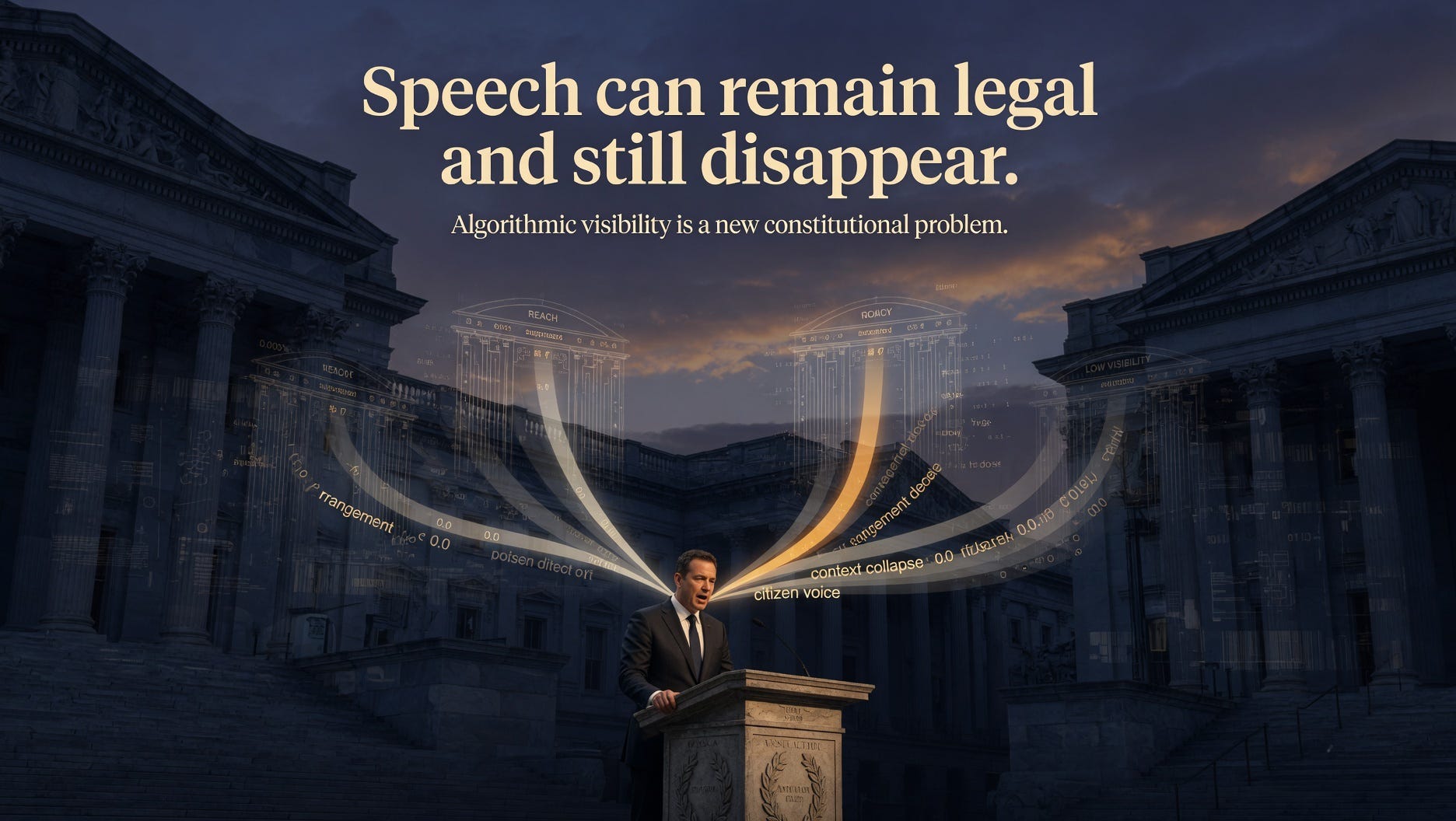
Aaron Kheriaty’s recent essay, The Future of Free Speech, raises one of the most important questions of the coming decade:
who is accountable when censorship is no longer carried out by visible officials, but by opaque systems?
His concern is not speculative. The machinery of speech control is already becoming less visible, less attributable, and more infrastructural. Speech is not only removed. It is ranked, throttled, deboosted, filtered, deprioritised, and quietly buried. The most effective censorship may no longer announce itself as censorship at all.
In the older model, suppression had a human face. A government official. A censor. An editor. A bureaucrat. A platform executive. Someone could be identified. Someone could be challenged. Someone could be held responsible.
But algorithmic mediation changes the structure of power.
A person may speak freely in the formal sense while being rendered invisible in the practical sense. A post may remain online while its reach is computationally restricted. A view may not be banned, but its capacity to enter public deliberation may be silently curtailed.
This creates a new problem for free expression:
the illusion of liberty under conditions of invisible control.
Aaron is right to identify this as a serious threat.
But beneath the problem of AI-enabled censorship sits an older and deeper jurisprudential fragility.
The danger is not only that algorithms may suppress speech.
The danger is that they may inherit a legal and cultural order that has already lost confidence in what speech is for.
The older question beneath the new machinery
Modern debates about free speech usually begin too late.
They begin with censorship, misinformation, platform governance, hate speech, safety, democratic stability, or regulatory overreach. These are real issues. But they often conceal a more fundamental question:
what is speech?
Is speech merely self-expression?
Is it preference assertion?
Is it participation in democratic process?
Is it a marketplace transaction in the competition of ideas?
Or is it something deeper: the outward act of rational beings seeking truth together?
That question matters because every legal order protects speech according to what it believes speech is.
If speech is merely preference, it can be managed against other preferences.
If speech is merely autonomy, it can be balanced against competing autonomy claims.
If speech is merely democratic function, it can be restricted whenever institutions decide that democracy itself is at risk.
But if speech is participation in reason ordered toward truth, then its protection rests on something deeper than utility.
It becomes a condition of political community itself.
This was the older insight of the higher law tradition. In classical jurisprudence, law was not merely enacted will. It was an ordinance of reason directed toward the common good. Speech was not primarily an act of self-creation. It was the externalisation of rational judgment within a community ordered toward truth and justice.
That tradition did not imply that every utterance was equally good. Nor did it deny that speech can be abused. It simply understood that rational creatures require the freedom to deliberate about truth without arbitrary domination.
Freedom of speech, in that framework, is not a concession from power.
It is a requirement of reasoned political life.
The proceduralisation of speech
Modern constitutional law often protects speech powerfully, but thinly.
In the United States, free speech doctrine has frequently relied on the marketplace of ideas, individual autonomy, anti-orthodoxy, and democratic self-governance. These are not trivial justifications. They have secured real protections.
But they are largely procedural or functional. They often defend speech because it helps democracy operate, because it permits individual self-expression, or because truth is assumed to emerge from competition.
In Australia, the position is even more structurally explicit. The implied freedom of political communication is not a personal right to speech. It is a limitation on government power derived from the requirements of representative and responsible government. Speech is protected insofar as it sustains the constitutional system.
The American and Australian frameworks differ greatly. But they share a common feature: neither fully grounds free expression in a thick account of truth as a public good.
This matters.
A procedural defence of speech can be strong in stable times. But under pressure, it becomes vulnerable to recalibration.
If speech is protected because it serves democracy, then speech can be restricted when authorities claim democracy is threatened.
If speech is protected because it serves autonomy, then speech can be restricted when it is said to impair the autonomy or dignity of others.
If speech is protected because of marketplace competition, then speech becomes fragile once the marketplace itself is engineered by platforms, algorithms, and attention systems.
The issue is not that modern constitutional doctrine has failed completely.
The issue is that it has become metaphysically underdeveloped.
It protects speech without always being able to explain, at sufficient depth, why speech deserves protection even when it is disruptive, unpopular, destabilising, or inconvenient.
Algorithmic mediation exposes the weakness
The algorithmic age does not create this fragility from nothing.
It scales it.
Digital platforms do not simply host speech. They structure visibility. They decide what is amplified, what is buried, what is recommended, what is demonetised, what is flagged, and what is made socially legible.
This means the future of speech is not only about whether someone is legally permitted to speak.
It is about whether speech can enter the field of shared attention.
And attention is increasingly governed by systems that do not understand truth, prudence, justice, or the common good.
They optimise.
They optimise for engagement, relevance, safety, retention, compliance, reputation risk, advertiser comfort, and institutional pressure.
None of these is equivalent to truth.
None is equivalent to reasoned deliberation.
None is equivalent to the common good.
This is why algorithmic censorship is so difficult to confront. It does not always look like the old suppression of speech. It often looks like optimisation. It appears as ranking, moderation, trust and safety, risk mitigation, user experience, community standards, or anti-misinformation infrastructure.
But when these systems operate within a culture that has no settled account of what speech is for, optimisation fills the vacuum.
The result is not simply censorship.
It is the infrastructural reconditioning of public reason.
The problem is institutional cognition
This is where the free speech debate intersects with a broader problem: institutional cognition.
Institutions do not merely make decisions. They reason. They remember. They prioritise. They classify. They deliberate.
When AI systems enter these processes, they do not simply accelerate existing workflows. They reshape the conditions under which institutional judgment occurs.
Speech governance is one instance of this larger transformation.
A platform deciding what counts as harmful speech is not merely moderating content. It is exercising quasi-institutional judgment over public visibility.
A government pressuring platforms to suppress certain narratives is not merely regulating speech. It is altering the cognitive environment within which citizens deliberate.
An AI system ranking, filtering, summarising, or suppressing expression is not merely performing a technical function. It is participating in the architecture of public reason.
The question, then, is not only:
who censored this speech?
The deeper question is:
what kind of institutional reasoning system made this speech visible, invisible, credible, suspect, amplified, or buried?
That is a different governance frontier.
It requires more than free speech absolutism and more than moderation policy. It requires truth infrastructure: systems of provenance, reasoning visibility, evidentiary continuity, institutional accountability, and procedural traceability.
In practice, this means systems capable of showing why information was suppressed, how rankings were altered, what evidentiary basis justified intervention, what institutional rule was applied, and who remained accountable for the decision.
Without that infrastructure, speech governance becomes opaque managerial power.
AI cannot supply the telos law has forgotten
There is a temptation to treat this as a technical problem.
Better models.
Better transparency tools.
Better content moderation rules.
Better appeals processes.
These may all help. But they cannot resolve the deeper problem.
AI systems cannot supply a moral anthropology. They cannot tell us what speech is for. They cannot determine the proper relationship between truth, liberty, authority, and the common good.
They inherit the assumptions of the institutions that deploy them.
If a legal culture treats speech as preference expression, AI will manage preferences.
If a platform treats speech as engagement, AI will optimise engagement.
If a regulator treats speech as risk, AI will minimise risk.
If an institution treats speech as a threat to stability, AI will help stabilise the institution.
Technology tends to scale the theory of speech embedded beneath the institutions that deploy it.
This is why the coming conflict over free expression cannot be addressed only at the level of platform policy or constitutional litigation. Those battles matter. But they are downstream of a more basic question.
Do we still understand speech as participation in reason ordered toward truth?
Or have we reduced it to a variable in systems of management?
Freedom requires more than permission
A society may formally permit speech while structurally disabling its public force.
That is the distinctive danger of the algorithmic age.
The citizen is not silenced in the old sense. He is simply made less visible. Less searchable. Less recommended. Less monetisable. Less socially transmissible. His speech remains available in theory while being neutralised in practice.
This produces a subtle but profound shift.
Freedom becomes formal.
Control becomes infrastructural.
Accountability becomes diffuse.
And public reason becomes dependent on systems few people can inspect, challenge, or understand.
Aaron Kheriaty’s warning should therefore be taken seriously. The future of censorship may not be a censor with a red pen. It may be a distributed system of automated suppression with no clear locus of moral responsibility.
But the response must go deeper than resisting censorship alone.
We must recover the foundations that make censorship intelligibly wrong.
Freedom of speech is not merely a pragmatic arrangement for pluralistic societies. It is not merely a safety valve. It is not merely an instrument of democratic procedure.
It is the social condition required for rational beings to seek truth together.
When that foundation is lost, speech remains protected only so long as institutions find it useful.
And what is useful can change.
Toward truth infrastructure
The future of free speech will require legal vigilance. It will require constitutional courage. It will require resistance to both state and private systems of invisible control.
But it will also require something more foundational.
We need institutions capable of preserving the conditions of truthful deliberation under technological mediation.
That means systems designed around:
reasoning visibility,
procedural traceability,
evidentiary continuity,
contestability,
memory governance,
and accountability for AI-mediated judgment.
These are not merely technical safeguards. They are institutional expressions of a deeper principle: speech must remain ordered toward truth, and power must remain answerable to reason.
The age of AI does not merely threaten free expression.
It reveals whether our defence of free expression was ever deep enough.
If freedom of speech is grounded only in process, autonomy, or utility, it will remain vulnerable to the next institutional claim of emergency, safety, harmony, or democratic protection.
But if speech is understood as participation in reason ordered toward truth, then its protection becomes more than strategic tolerance.
It becomes a requirement of justice.
The future of free speech will not be secured by nostalgia for an earlier internet, nor by trusting platforms to manage discourse benevolently, nor by asking algorithms to become wise.
It will require a recovery of the moral architecture beneath law itself.
Without that recovery, algorithms will not merely censor speech.
They will inherit our confusion about why speech matters.