AI Cannot Seek Truth Without Philosophy
Why truth-seeking AI requires more than larger models.

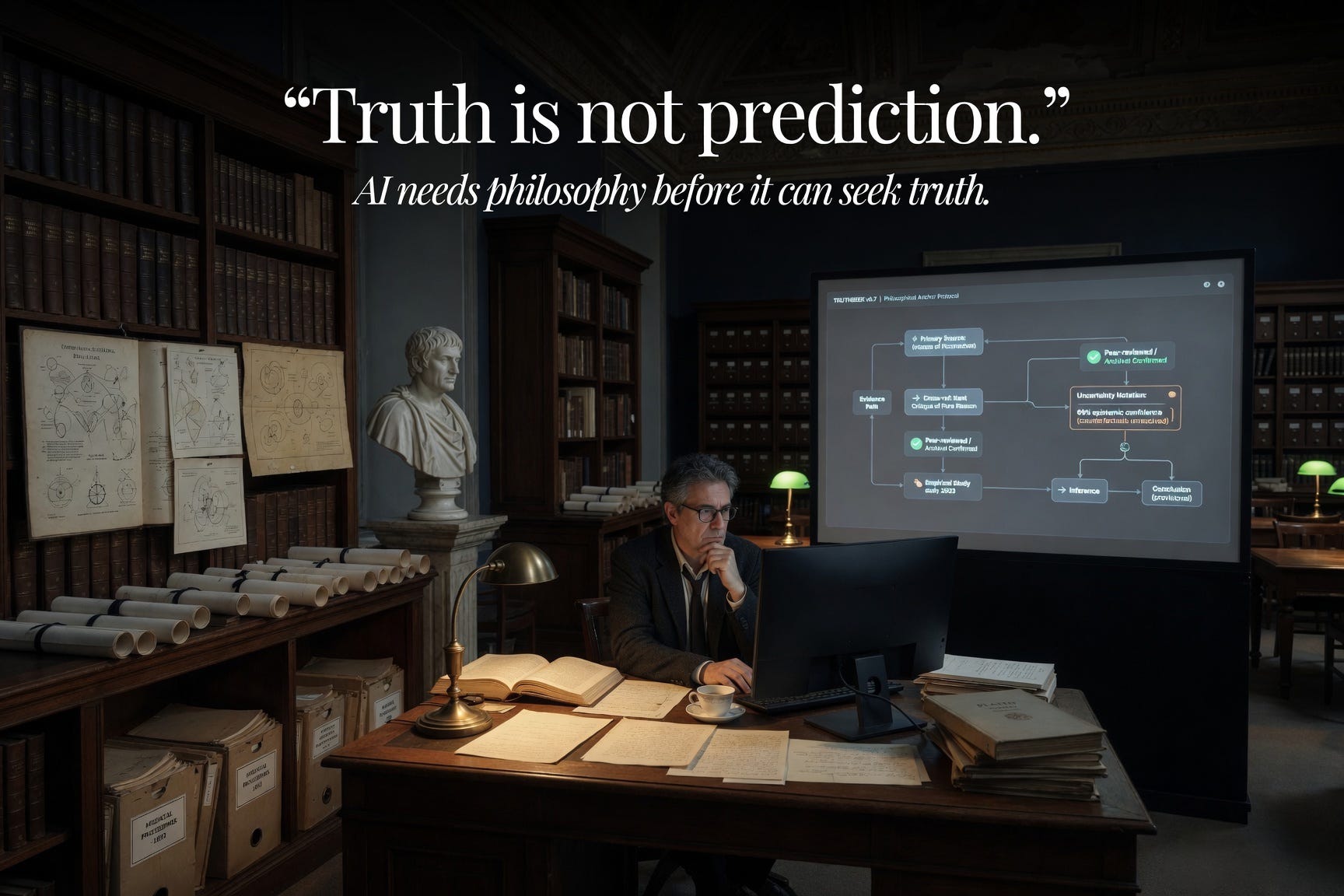
This is Part II of the Truth Infrastructure series.
Part I argued that artificial intelligence is becoming part of the systems through which civilisation determines what is true.
Part II asks a deeper question:
Can AI seek truth if it has no coherent understanding of what truth is?
Artificial intelligence companies increasingly describe their systems as “truth-seeking.”
The ambition is understandable. As AI systems become embedded in scientific research, legal analysis, and medical decision-making, their reliability becomes a civilisational issue. Systems that influence how societies determine what is true cannot simply optimise engagement or statistical plausibility.
They must be designed to discover truth.
Yet the current debate about truth-seeking AI often overlooks a deeper problem.
Artificial intelligence cannot seek truth unless it is built upon a coherent philosophical understanding of what truth actually is.
Without such foundations, the phrase “truth-seeking AI” risks becoming little more than a marketing slogan.
The Competition Between AI Labs
The rivalry among major AI companies illustrates this challenge.
OpenAI emphasises safety, alignment, and increasingly powerful generative models.
Anthropic focuses on “constitutional AI,” attempting to guide models through predefined principles and rules.
xAI, founded by Elon Musk, has articulated a more direct ambition: building systems that seek truth and attempt to understand the nature of reality.
These approaches reflect different answers to the same question: what should advanced AI systems optimise?
Should they maximise engagement?
Prediction accuracy?
Human approval?
Or should they aim at something deeper - truth itself?
The answer matters because artificial intelligence is rapidly becoming part of civilisation’s truth infrastructure.
The Architecture of Truth
Modern societies depend on institutions that reliably determine what is real.
Courts determine facts about events.
Science determines the structure of the natural world.
Medicine determines diagnoses and treatments.
These institutions form what might be called truth infrastructure - the systems through which societies discover and verify reality.
If these systems fail, justice fails with them.
Artificial intelligence is now being integrated into these institutions.
AI systems assist legal research, analyse scientific data, and help interpret medical images. Increasingly, they shape how knowledge is discovered and evaluated.
But most current AI systems were not designed primarily to discover truth.
They were designed to predict patterns.
Large language models generate text by estimating which sequence of words is statistically most likely to appear next. Their outputs often sound authoritative and coherent, but this coherence arises from probabilistic inference rather than from a direct relation to reality.
The system does not ask whether a claim corresponds to the world.
It asks which sentence is most likely.
This difference explains why AI systems sometimes produce confident falsehoods - so-called hallucinations.
The outputs are plausible.
They are not necessarily true.
The Missing Philosophical Layer
The difficulty arises because the concept of truth is not purely technical.
It is philosophical.
For centuries, philosophers described truth as the correspondence between thought and reality. A statement is true when it accurately describes the world.
This idea may appear simple, but it carries profound implications.
The classical tradition went further. It understood truth-seeking not as neutral pattern-matching but as participation in reason ordered toward reality itself - what Aristotle called logos, and what Thomas Aquinas later framed as law as an “ordinance of reason” directed to the common good. Truth was not merely statistical coherence; it was correspondence with an objective order that human judgment must serve.
If truth involves correspondence with reality, then systems designed to discover truth must be oriented toward reality itself. They must possess mechanisms that allow them to test claims against evidence and distinguish verified knowledge from speculation.
In other words, truth-seeking requires epistemic architecture.
Artificial intelligence today possesses extraordinary pattern-recognition capabilities, but pattern recognition alone does not guarantee truth.
A system trained solely to predict the next token in a sequence may produce answers that sound convincing while remaining detached from verifiable reality.
To build truth-seeking AI, therefore, requires more than scaling models and expanding datasets.
It requires a philosophical framework that treats truth as the governing aim of the system.
Truth Infrastructure in the AI Age
The challenge becomes clearer when AI is viewed as part of truth infrastructure.
Just as physical infrastructure supports transportation and energy systems, truth infrastructure supports the discovery and verification of knowledge.
Courts rely on evidentiary rules. Science relies on experimental verification. Medicine relies on diagnostic testing.
These mechanisms exist to ensure that judgments correspond to reality rather than speculation.
Artificial intelligence must operate within this architecture rather than outside it.
Artificial intelligence must therefore be designed within this architecture: to distinguish verified knowledge from probabilistic inference, ground outputs in verifiable evidence, signal uncertainty clearly, and support - rather than supplant - human practical wisdom (phronesis).
Such systems would not merely generate plausible responses. They would function as tools for strengthening the institutions through which societies determine truth.
Practical Wisdom and Human Judgment
Even the most sophisticated AI systems cannot eliminate the need for human judgment.
The classical philosophers called this capacity Phronesis - the ability to apply knowledge to particular circumstances through practical reasoning.
Judges must evaluate credibility. Physicians must balance treatment risks. Scientists must interpret experimental results.
These judgments cannot be reduced entirely to computation.
Artificial intelligence should therefore be designed to assist human practical wisdom rather than attempt to replace it.
Systems that provide reliable information, highlight relevant evidence, and reveal hidden patterns can dramatically improve human decision-making.
But only if they remain anchored in truth.
The Future of Truth-Seeking AI
The current competition among AI laboratories is often framed as a race for capability.
In reality, it may be something more fundamental.
It is a search for the philosophical architecture capable of sustaining trustworthy artificial intelligence.
The companies that succeed will not simply build larger models.
They will build systems whose design reflects the requirements of truth infrastructure itself.
In an age increasingly shaped by artificial intelligence, the future of justice, science, and medicine depends on this distinction.
Artificial intelligence will inevitably become part of civilisation’s epistemic foundations.
The question is whether it will strengthen those foundations—or quietly erode them.
Because a civilisation that loses the ability to distinguish truth from plausibility cannot long preserve the institutions that depend upon that distinction.
And those institutions include justice itself.
—
FIA Labs builds AI systems for real-world decision-making.
Continue following the Truth Infrastructure series: