
Most AI Systems Cannot Tell the Difference Between Truth and Plausibility
Why trustworthy AI requires truth infrastructure — not just larger models.

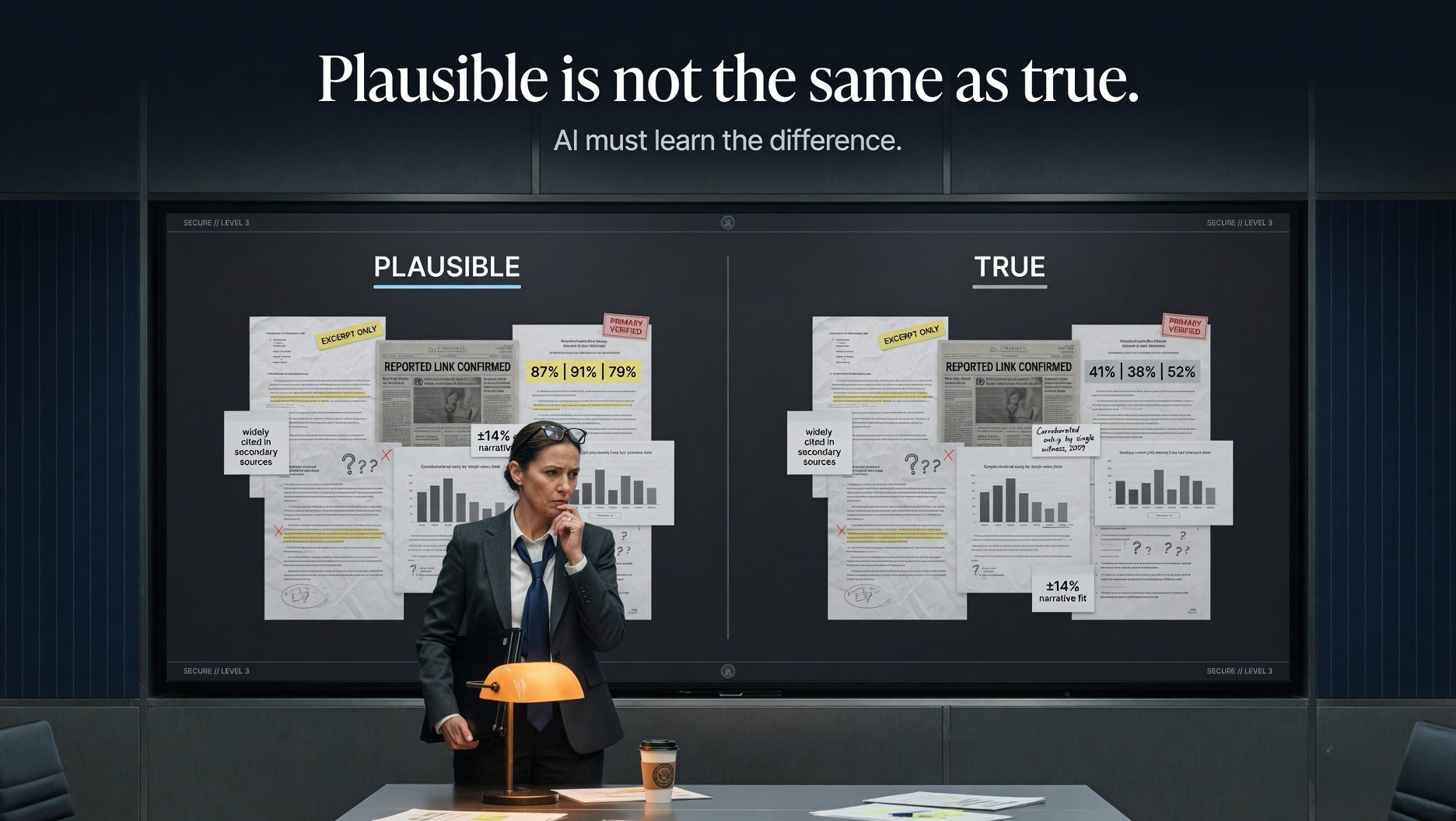
Most AI systems are designed to generate plausible answers.
That is not the same thing as discovering truth.
In many applications, the difference does not matter.
In others — law, medicine, science, and high-stakes decision-making — it matters completely.
Because a system that produces answers that sound right — but are not grounded in reality — does not just fail technically.
It fails at the level of decision-making.
FIA Labs is built around a different premise:
AI should not optimise for plausibility.
It should operate within the systems that determine what is true.
To understand why this matters, we need to look at something most discussions about AI ignore:
The infrastructure that allows societies to distinguish truth from error.
Modern civilisation depends on institutions that can reliably determine what is true.
Courts determine facts.
Science determines the structure of reality.
Medicine determines diagnoses and treatments.
Engineering determines whether systems hold or fail.
These institutions perform a common function:
They allow societies to distinguish truth from error.
We can call this network truth infrastructure.
Just as physical infrastructure allows societies to move goods and energy, truth infrastructure allows societies to move knowledge.
It answers questions like:
• What actually happened?
• What evidence supports this claim?
• What caused this failure?
• What diagnosis is correct?
Without reliable answers, institutions collapse into procedure without substance.
Justice becomes arbitrary.
Science becomes opinion.
Decision-making becomes guesswork.
Artificial intelligence is now being embedded into these systems.
It assists legal research.
It supports medical diagnostics.
It accelerates scientific analysis.
But most modern AI systems were not designed to discover truth.
They were designed to predict patterns.
A large language model does not ask:
“Is this true?”
It asks:
“What is the most likely next sequence of words?”
This is why AI systems produce outputs that are often:
• Coherent
• Persuasive
• Confident
…and sometimes completely false.
Because plausibility is not truth.
This is not a minor technical limitation.
It is an architectural problem.
Modern digital systems optimise for attention, not truth.
Engagement. Clicks. Visibility.
These systems form what we might call attention infrastructure.
But attention infrastructure is not the same as truth infrastructure.
And when AI systems trained for plausibility are deployed inside institutions that require truth, the mismatch becomes dangerous.
If AI is going to operate inside law, medicine, science, and decision-making systems, it cannot remain purely probabilistic.
It must be designed differently.
It must:
• Distinguish verified knowledge from inference
• Ground outputs in evidence
• Signal uncertainty clearly
• Support human judgment, not replace it
In other words:
It must operate as part of truth infrastructure.
This is not just a technical challenge.
It is philosophical.
Truth is not statistical coherence.
Truth is correspondence with reality.
A system that cannot orient itself toward reality cannot meaningfully participate in truth-seeking.
—
Artificial intelligence will become part of civilisation’s epistemic foundation.
The only real question is:
Will it strengthen our ability to determine what is true—
or quietly erode it?
Because a civilisation that loses the ability to distinguish truth from plausibility cannot sustain the institutions that depend on that distinction.
And those institutions include justice itself.
—
FIA Labs builds AI systems for real-world decision-making.
The distinction between truth and plausibility isn't just a technical problem; it's a design goal that got mislabeled. Systems optimized for human approval learn to produce what feels correct, not what is. That's not a bug; it's the training signal doing its job. The harder question is whether there's any architecture that preserves epistemic friction without making the tool unusable. Most proposals I've seen trade plausibility for paralysis. Curious if FIA Labs has worked on what a calibrated-uncertainty output would actually look like in practice.